


 (305) 876-6001

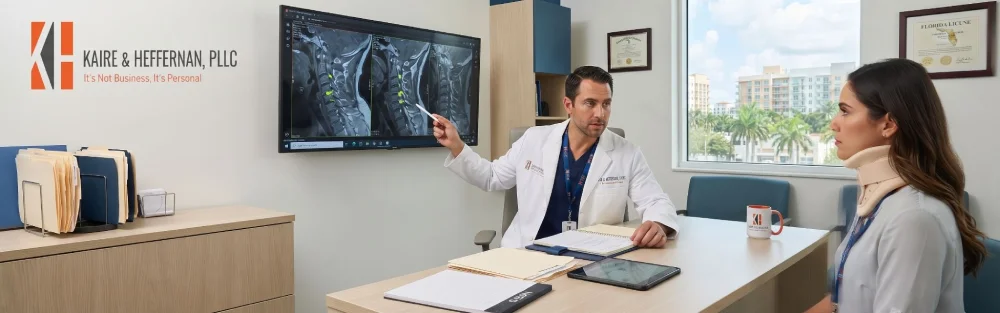
Why Medical Treatment Timing Matters After a Car Accident in Aventura and Miami
Florida’s Personal Injury Protection (PIP) law generally requires an injured person to receive qualifying initial services and care within 14 days after a motor vehicle accident to be eligible for PIP medical benefits. The care must be provided by a provider or facility authorized by the statute. Missing the deadline can jeopardize PIP medical benefits, Fla. Stat. § 627.736(1)(a)
Key Takeaways
- The 14-day requirement: To qualify for PIP medical benefits, an injured person generally must receive qualifying initial services and care within 14 days after the accident. The statute specifies eligible providers and facilities, so not every medical visit necessarily satisfies the requirement. Fla. Stat. § 627.736(1)(a)
- The Emergency Medical Condition (EMC) determination: Florida law allows up to $10,000 in PIP medical benefits when an authorized provider determines that the injured person had an EMC. The providers authorized to make that determination include a physician, dentist, physician assistant, or advanced practice registered nurse. If a specified provider determines that the person did not have an EMC, the statute limits medical benefits to $2,500. Fla. Stat. § 627.736(1)(a)
- Symptoms and treatment can vary: Some symptoms may not be apparent immediately after a collision. Anyone who is injured or concerned about symptoms should seek appropriate medical care.
- Documentation may help, but does not guarantee a result: Prompt care and accurate medical records can help document reported symptoms, the timing of treatment, and the care received. They do not guarantee that an insurer will accept that an injury was caused by the accident, that treatment was medically necessary, or that the amount claimed is covered.
- Because the 14-day requirement can affect eligibility for PIP medical benefits, anyone involved in a crash should promptly confirm how the statutory requirements apply to their circumstances.
What is the legal definition and operational scope of Florida’s 14-day PIP rule?
Under Florida law, Personal Injury Protection (PIP) mandates that any person injured in a motor vehicle collision must obtain initial medical services and care within 14 calendar days of the accident to preserve insurance coverage. This strict temporal constraint applies across Miami, Aventura, Coral Gables, North Miami, and Fort Lauderdale and all of Florida, regardless of who caused the crash. Insurance adjusters exploit any lapse past this 14-day threshold to argue that injuries are unrelated, exaggerated, or entirely non-existent.
Why do delayed symptoms after an Aventura or Miami collision jeopardize personal injury claims?
Physiological stress responses and adrenaline surges immediately following a crash frequently mask severe internal injuries, delaying symptom onset by 24 to 72 hours. Victims involved in high-speed pileups on the Palmetto Expressway or surface street impacts near Aventura Mall often feel fine initially, only to experience debilitating whiplash, herniated discs, or cognitive deficits days later. Waiting for pain to subside naturally rather than undergoing immediate diagnostic imaging gives insurance carriers grounds to dispute medical causation.
Which medical professionals are authorized under Florida law to satisfy the 14-day rule?
Only specific licensed medical practitioners recognized under Florida Statute § 627.736 can render “initial services and care” that successfully satisfy the mandatory 14-day window. Qualifying practitioners include medical doctors (MDs), doctors of osteopathic medicine (DOs), emergency room physicians, licensed dentists for maxillofacial trauma, physician assistants (PAs), advanced practice registered nurses (APRNs), and chiropractic physicians. Visiting alternative wellness providers like massage therapists or acupuncturists as a first point of contact fails to satisfy the statutory mandate.
How does an Emergency Medical Condition (EMC) diagnosis affect your insurance payout limits?
An Emergency Medical Condition (EMC) determination made by an authorized MD, DO, PA, or APRN unlocks the full $10,000 threshold of available PIP medical and disability benefits. Without a formal written EMC diagnosis certifying that acute symptoms risk serious dysfunction or organ failure, insurance companies restrict maximum medical payouts to a severe cap of $2,500. Chiropractors can satisfy the initial 14-day rule, but under Florida law, they are unauthorized to issue an EMC designation.
What evidence do insurance adjusters use to attack treatment gaps in Miami accident cases?
Insurance carriers scrutinize medical timelines to construct defense narratives claiming that intervening events caused the claimant’s injuries. When accident victims delay evaluation, defense teams assert that gaps in treatment demonstrate minor trauma or healed pre-existing conditions. Our trial lawyers at Kaire & Heffernan counter these bad-faith tactics by introducing immediate emergency department records, advanced diagnostic imaging, and expert biomechanical testimony to prove causation.
How do multi-car accidents on I-95 and SR-826 complicate injury timelines and liability?
Multi-vehicle collisions on congested regional arteries create complex chains of liability where latent injuries emerge days after the initial impact. High-velocity impacts generate severe rapid deceleration forces that strain cervical and lumbar spinal structures beyond biological thresholds. Prompt medical screening following accidents on major South Florida transit corridors ensures that hidden neuropathic or orthopedic damage is formally logged into medical records before insurers dispute liability.
Why is contemporaneous medical documentation essential for overcoming bad-faith insurance denials?
Contemporaneous medical notes written during the first two weeks following a crash serve as the definitive baseline for proving damages in court. Insurers frequently hire independent medical examiners (IMEs) to dispute the necessity of ongoing care. Securing consistent clinical documentation from local facilities such as Aventura hospital emergency rooms or Miami urgent care centers safeguards your claim against aggressive corporate defense strategies.
What steps should you take if your initial 14-day PIP window is closing or has passed?
If your 14-day window is expiring or has already lapsed, you must seek immediate medical evaluation and consult our experienced personal injury attorneys to explore liability claims against the at-fault driver. While missing the 14-day deadline forfeits your no-fault PIP protection, you can still pursue compensation through bodily injury liability coverage, uninsured motorist (UM) policies, or third-party tort claims.
How do defense lawyers and corporate insurers weaponize delayed treatment against victims?
Defense counsel routinely portrays delayed medical care as proof that a plaintiff’s pain is unverified or unrelated to the collision. Juries rely heavily on temporal proximity between the trauma and the first medical visit when evaluating pain and suffering damages. Establishing a clear paper trail from day one dismantles defense arguments and proves the true severity of your injuries. Read further about our strategic approach on our Miami car accident lawyer practice page.
When should you retain legal counsel to protect your medical and financial recovery rights?
You should retain legal counsel immediately following a motor vehicle collision to prevent insurance adjusters from manipulating your statements or exploiting statutory deadlines. Navigating Florida’s complex no-fault insurance framework requires aggressive advocacy and deep investigative resources.
About the Team at Kaire & Heffernan
Founded by seasoned trial attorneys Mark A. Kaire and David R. Heffernan, our Miami car accident and personal injury legal team brings decades of courtroom experience dedicated to protecting crash victims from aggressive insurance adjusters and corporate defense tactics. Navigating Florida’s strict 14-day PIP rule, proving Emergency Medical Condition (EMC) determinations, and overcoming bad-faith treatment-gap arguments require rigorous trial readiness and immediate, exhaustive investigative resources. Operating throughout Miami, Aventura, Coral Gables, North Miami, Fort Lauderdale, and across Florida, our attorneys stand fiercely protective of your rights at every stage of litigation to secure maximum compensation for catastrophic injury victims.