


 (305) 876-6001

What Not to Say to Insurance Adjusters: Protecting Your Personal Injury Claim in Florida
Insurance adjusters are trained professionals whose primary objective is to minimize payouts or deny liability entirely, often using recorded statements against claimants. When speaking with an insurance adjuster after an accident in Florida, avoid making recorded statements, guessing about speed or distance, admitting partial fault, or downplaying your physical injuries. Protecting your claim requires strict adherence to strategic communication protocols designed to preserve your legal rights under Florida law. Talk to our legal team before making “any” statements to the insurance company.
Key Takeaways: Protecting Your Florida Injury Claim
- Recorded Statements: You rarely have a legal obligation to provide an immediate recorded statement to the other party’s insurance carrier without legal representation.
- Statute of Limitations: Under Florida law, you must file most personal injury lawsuits within two years of the incident date (Fla. Stat. § 95.11).
- Comparative Fault: Florida operates under a modified comparative fault standard (Fla. Stat. § 768.81), meaning any admission of partial fault can directly reduce your financial recovery.
- Pre-Suit Investigation: Insurance carriers aggressively monitor social media and initial communications to exploit inconsistencies during pre-suit negotiations.
Why Insurance Adjusters Are Not on Your Side
Insurance companies operate as for-profit enterprises, so every dollar paid out in a settlement reduces their revenue. Adjusters employ sophisticated psychological tactics, projecting a friendly or empathetic demeanor to lower your guard. They frequently contact claimants hours or days after a traumatic event when victims are vulnerable, fatigued, or medicated.
Understanding how insurance adjusters evaluate risk helps our Miami personal injury attorneys protect your claim from predatory tactics. Whether your incident occurred in a high-traffic corridor in Miami, a commercial parking lot in Aventura, a busy intersection in Coral Gables, or along I-95 near Fort Lauderdale, insurance adjusters follow identical playbooks designed to devalue your losses. Research published by the Agency for Healthcare Research and Quality (AHRQ), along with insurance industry studies, shows that early, unrepresented statements account for a significant percentage of prematurely closed or undervalued claims.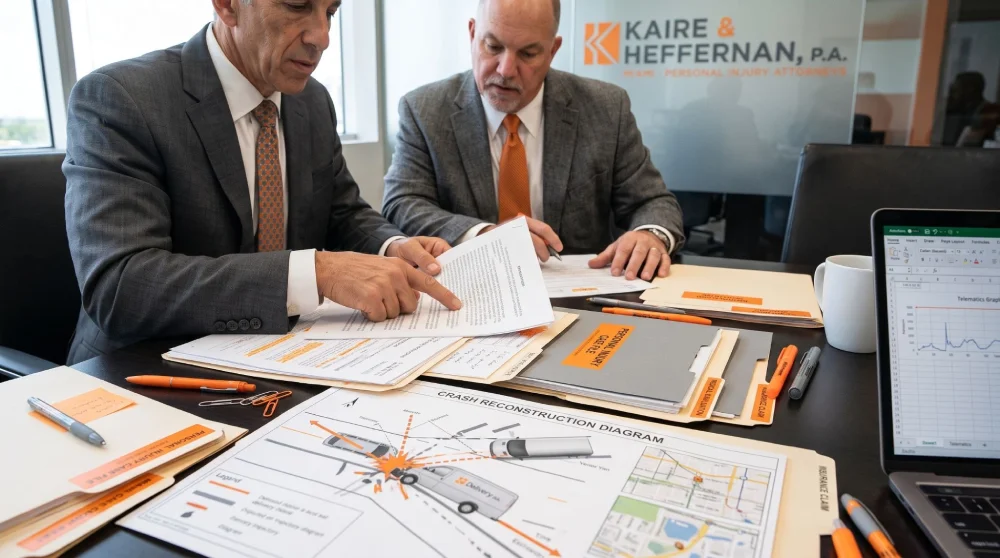
What Are the Most Dangerous Statements to Make to an Insurance Adjuster?
Directly beneath every inquiry lies a trap designed to elicit premature admissions that undermine causation and damages. Below are the specific phrases and responses you must avoid during any interaction with an insurance representative.
1. “I’m doing fine” or “I feel okay”
Never tell an insurance adjuster that you are feeling fine, doing well, or recovering nicely immediately following an accident. Polite social reflexes often prompt people to say “I’m fine” when asked how they are doing. Adjusters weaponize this standard courtesy, logging it in their database as formal proof that you sustained no physical injuries or emotional trauma. Soft-tissue injuries, traumatic brain injuries (TBIs), and internal trauma often manifest symptoms hours or days after the initial impact due to adrenaline masking the pain.
2. “I’m sorry” or “I didn’t see them”
Avoid offering any variation of an apology, even out of politeness, or speculating on how the accident happened. In Florida negligence actions, an offhand apology can be misconstrued by an adjuster as an admission of legal liability. You must establish liability through objective evidence, police reports, and forensic reconstruction—not speculative roadside commentary.
3. Speculating on Speeds, Distances, or Timelines
Never guess or estimate vehicle speeds, braking distances, or exact timestamps when asked by an adjuster. If you state that a vehicle “seemed to be going about 30 miles per hour,” the insurance defense team will hire an accident reconstruction expert to lock you into that estimate. If physical evidence later proves the speed was 45 miles per hour, your credibility is instantly shattered, providing the carrier grounds to allege comparative negligence.
4. Agreeing to an Immediate Recorded Statement
Refuse requests for a recorded statement until you have consulted with our medical malpractice legal team or personal injury counsel. Insurance adjusters intentionally use leading questions designed to box you into inconsistent narratives. They will ask complex questions about medical history or pre-existing conditions, hoping you will inadvertently attribute current pain to past injuries.
How Does Florida’s Legal Framework Impact Your Conversations with Insurers?
Navigating communications requires a precise understanding of Florida’s statutory rules governing tort claims and insurance bad faith.
The Comparative Fault Trap
Under Florida Statutes § 768.81, Florida follows a modified comparative fault rule. If a plaintiff is found more than 50% at fault for their own injuries, they cannot recover any damages. Insurance adjusters actively look for conversational openings to get you to accept 10% or 20% of the blame (“Maybe I shouldn’t have been in that lane,” or “I looked away for a second”). Once they capture that snippet on a recorded line, they use it to reduce your compensation proportionally or bar recovery entirely. DO not talk to the insurance company without getting advice from the Kaire & Heffernan legal team first.
Pre-Suit Communication Standards
Insurance carriers must follow statutory claim-handling requirements, but they routinely exploit unrepresented claimants during the adjustment phase. When our trial lawyers at Kaire & Heffernan step in to manage communications, we channel all correspondence through our office. This eliminates the risk of accidental disclosures.

Comprehensive Q&A: Protecting Your Claim in Miami and Beyond
1. Should I speak to the other driver’s insurance adjuster at all?
You are under no legal obligation to speak with the at-fault party’s insurance adjuster without an attorney. Directing them to your legal counsel protects you from manipulative questioning. You must cooperate with your own insurance carrier under specific policy cooperation clauses, and even then, legal representation helps protect your statements.
2. What if the insurance adjuster calls me right after the accident from the hospital?
Refuse to answer substantive questions and state that you are receiving medical care and will have your attorney contact them. Adjusters frequently call hospitals or homes during the immediate post-accident window precisely when victims are medicated, vulnerable, and unable to protect their interests.
3. Can an adjuster use my social media posts against my claim?
Yes, insurance companies routinely hire investigators to scour social media profiles for photos or statements that contradict your injury claims. Posting a picture of yourself smiling at a family gathering or stating that you attended an event can be taken entirely out of context by an adjuster to argue that your injuries are exaggerated or fabricated.
4. Is it safe to sign a medical authorization form sent by an adjuster?
Never sign a blank or broad medical authorization form provided by an opposing insurance company. These blanket releases give adjusters legal permission to dig through your entire medical history spanning decades, allowing them to unearth unrelated pre-existing conditions and falsely blame them for your current pain.
5. What should I do if the insurance company offers a quick cash settlement?
Reject immediate settlement offers until you have reached maximum medical improvement (MMI) and understand the full scope of your future damages. Early lowball offers are calculated to settle claims before hidden injuries—such as spinal disc herniations or neurocognitive trauma—are fully diagnosed and treated.
6. Do I have to give details about my past medical history to the adjuster?
You are not obligated to grant unrestricted access to your medical background to an opposing adjuster. While accident-related injuries must be documented, handing over unverified access invites bad-faith manipulation of your prior health records.
7. What if the adjuster records my phone call without my explicit permission?
In Florida, all parties generally must consent to recording telephone conversations under state wiretapping laws, but insurance representatives often state at the outset that the call is being recorded. Assuming every word you speak is being recorded and archived is the safest operational standard during any interaction with an insurance representative.
8. How do our Miami personal injury attorneys stop adjuster harassment?
Once you retain us, our legal team issues a formal letter of representation that legally requires all communication to go through our offices. This immediately stops harassing phone calls, text messages, and pressure tactics from aggressive adjusters, so you can focus on your medical recovery across Miami, Aventura, Coral Gables, and Fort Lauderdale.
9. What role do independent medical examinations (IMEs) play in adjuster communications?
Insurance companies often require an IME with a doctor of their choosing, whose primary goal is to minimize the severity of your injury. Adjusters scrutinize statements made to an IME doctor; therefore, preparing for these evaluations with skilled counsel is essential.
10. How can I schedule a confidential case evaluation with Kaire & Heffernan?
You can reach our trial attorneys directly by visiting our contact page or calling our office for a comprehensive case review. We evaluate every facet of your interaction with insurance carriers to ensure maximum financial recovery under Florida law.

About Kaire & Heffernan
With decades of dedicated courtroom experience in Miami and throughout Florida, our trial lawyers at Kaire & Heffernan have built an unyielding reputation for holding negligent parties, major corporations, and insurance carriers fully accountable. Our medical malpractice legal team and catastrophic accident attorneys combine meticulous investigative resources with fierce trial readiness to secure justice for injured victims. When insurance adjusters deny liability or try to reduce valid claims, our Miami personal injury attorneys stand firm to protect your constitutional rights and secure maximum compensation.