


 (305) 876-6001

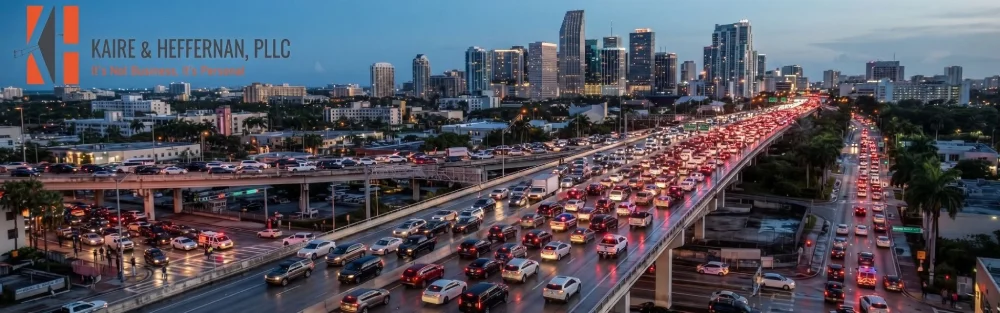
Navigating I-95 and SR-826 Multi-Car Pileups: Who Is Really at Fault?
A multi-car pileup on Interstate 95 or State Road 826 occurs when a chain-reaction collision involving three or more vehicles is triggered by sudden deceleration, driver inattention, or roadway hazards, creating complex overlapping liability claims among multiple motorists and commercial carriers.
Key Takeaways
- Statute of Limitations: Under Florida Statutes Section 95.11, actions founded on negligence must be commenced within two years from the date of the multi-vehicle crash.
- Modified Comparative Negligence: Florida follows a modified comparative fault framework (Section 768.81), meaning a plaintiff barred from recovery if found more than 50% at fault for the chain-reaction collision.
- Mandatory PIP Timelines: Motorists must seek initial professional medical treatment within 14 days of the accident to access Personal Injury Protection (PIP) benefits pursuant to Florida Statutes Section 627.736.
- Forensic Reconstruction Mandates: Multi-car pileups on high-speed arterial corridors demand immediate electronic data recorder (EDR) extractions and expert engineering analysis to untangle sequential impact vectors.
How Does Florida Comparative Fault Apply to Multi-Car Chain-Reaction Collisions on I-95 and Palmetto Expressway?
Chain-reaction collisions on congested South Florida interstates invoke complex apportionment rules where multiple drivers share fractional percentages of fault. When a lead motorist stops abruptly due to congestion on Interstate 95 through Miami or State Road 826 (the Palmetto Expressway) near Coral Gables and Aventura, trailing drivers who fail to maintain assured clear distance ahead often trigger secondary impacts. According to research published by the Federal Highway Administration (FHWA), multi-vehicle crashes involve cascading kinetic energy transfers that obscure the sequence of primary and secondary strikes.
Our Miami car accident lawyers utilize high-definition laser scanning, black-box telematics, and witness affidavits to isolate distinct impact vectors. Determining liability requires evaluating whether subsequent rear-end strikes were independent intervening causes or foreseeable results of the initial impact. We coordinate closely with highway safety analysts referencing data from the National Highway Traffic Safety Administration (NHTSA) to establish exact speed profiles, braking deceleration rates, and reaction intervals leading up to the disaster.
What Forensic Evidence Is Required to Prove Liability in a Major Multi-Vehicle Expressway Crash?
Establishing liability in a complex pileup requires immediate preservation of electronic control module data, traffic camera feeds, and skid mark telemetry.
- Engine Control Module (ECM) and EDR Extraction: Commercial semi-trucks and modern passenger vehicles house data recorders capturing pre-crash speed, throttle position, and brake application seconds before impact.
- State and Municipal Traffic Camera Retrieval: High-speed corridors monitored by the Florida Department of Transportation (FDOT) capture real-time traffic flow, though footage is routinely overwritten within short retention cycles.
- Accident Reconstruction Expert Testimony: Independent physicists map crash kinematics, vector angles, and crush measurements to disprove false assertions made by adversarial insurance adjusters.
- Cellular Phone and Telematics Subpoenas: Investigating driver distraction records helps prove whether text messaging or app engagement contributed to delayed braking responses.
- Immediate Site Inspections: Our Miami personal injury attorneys deploy investigators to record roadway friction coefficients, debris fields, and lane configurations before municipal maintenance crews alter the scene.
How Do Commercial Trucking Regulations Impact Pileups Involving Semi-Trucks on Fort Lauderdale Arteries?
Commercial freight carrier involvement introduces strict federal safety standards and higher insurance policy limits essential for recovering full compensation. When heavy commercial vehicles lose control on wet asphalt or fail to brake in heavy traffic streams along Interstate 95 or neighboring Fort Lauderdale corridors, the resulting devastation dwarfs standard passenger car collisions. Under oversight guidelines established by the Federal Motor Carrier Safety Administration (FMCSA), interstate carriers must comply with strict hours-of-service rules, vehicle maintenance mandates, and weight limits.
When driver fatigue, brake system failure, or improper cargo securement causes a jackknife or multi-car pileup, our trial lawyers at Kaire & Heffernan subpoena driver qualification files, electronic logging device (ELD) records, and maintenance logs. Reviewing baseline safety research from the Centers for Disease Control and Prevention (CDC) regarding commercial driver fatigue patterns allows our legal team to construct unassailable liability arguments against corporate trucking fleets.
Frequently Asked Questions: Multi-Car Pileup Claims in Florida
What is the legal doctrine governing rear-end collisions in Florida pileups?
Florida historically applies a rebuttable presumption of negligence against the rear driver in a rear-end collision, though this presumption is challenged when sudden unexpected stops or multi-car chain reactions occur. Our litigators deconstruct multi-vehicle sequences to prove that upstream negligence forced unavoidable secondary impacts.
How long do I have to file a lawsuit after an expressway pileup in Miami?
The statute of limitations under Florida law requires personal injury lawsuits to be formally filed within two years of the collision date. Failing to initiate litigation within this strict statutory timeframe permanently extinguishes your right to seek judicial relief.
What happens if several drivers share blame for a major expressway crash?
Under Florida’s modified comparative negligence statute, you may recover damages if your assigned percentage of fault does not exceed 50%, with your award reduced proportionally. If liability is distributed among three or more defendants, each party is held accountable for their specific percentage of comparative fault.
Why is immediate legal intervention critical after a multi-car pileup?
Essential digital evidence, municipal traffic footage, and physical skid marks degrade or get destroyed within days of a high-speed expressway crash. Prompt legal action ensures preservation letters are served before critical telematics data gets overwritten.
Can I seek compensation if the at-fault driver has minimal insurance coverage?
When an at-fault motorist carries insufficient bodily injury liability limits, your recovery relies heavily on stacking Uninsured/Underinsured Motorist (UM/UIM) coverage on your own auto policy. Our attorneys conduct comprehensive asset and policy checks to identify all available layers of insurance coverage.
What types of damages can be recovered in a catastrophic crash claim?
Recoverable compensation encompasses past and future medical treatments, surgical expenses, rehabilitation costs, lost wages, diminished earning capacity, and non-economic pain and suffering. Securing maximum financial recovery requires documenting long-term physical impairment and permanent scarring.
How do insurance adjusters attempt to devalue multi-car accident claims?
Insurance adjusters exploit the chaos of multi-vehicle collisions by pointing fingers between defendants to delay payouts or induce low-ball lump-sum settlements. Directing all opposing communications through our legal team blocks predatory adjuster tactics.
What role do eyewitnesses play in sorting out complex liability chains?
Independent eyewitnesses provide objective accounts of brake lights, erratic lane changes, and initial impact sequences that clarify conflicting driver statements. Securing immediate contact details from neutral bystanders prevents lost testimony as memories fade.
How do trial attorneys prove permanent injury thresholds in Florida courts?
Our legal team partners with board-certified orthopedic surgeons, neurologists, and forensic economists to establish that your physiological injuries meet Florida’s statutory threshold of permanent impairment. Objective diagnostic imaging and expert testimony validate your damages before judges and juries.
About Kaire & Heffernan
With decades of combined legal experience and more than $255 million recovered for injured victims, the trial lawyers at Kaire & Heffernan provide aggressive, unyielding representation throughout Miami, North Miami, Aventura, Fort Lauderdale, Coral Gables, and across Florida. Founded by seasoned litigators Mark A. Kaire and David R. Heffernan, our firm maintains a direct-access communication standard, equipping every client with personal cell phone numbers for round-the-clock availability. We stand ready to hold negligent drivers, commercial carriers, and insurance conglomerates fully accountable in the courtroom.