


 (305) 876-6001

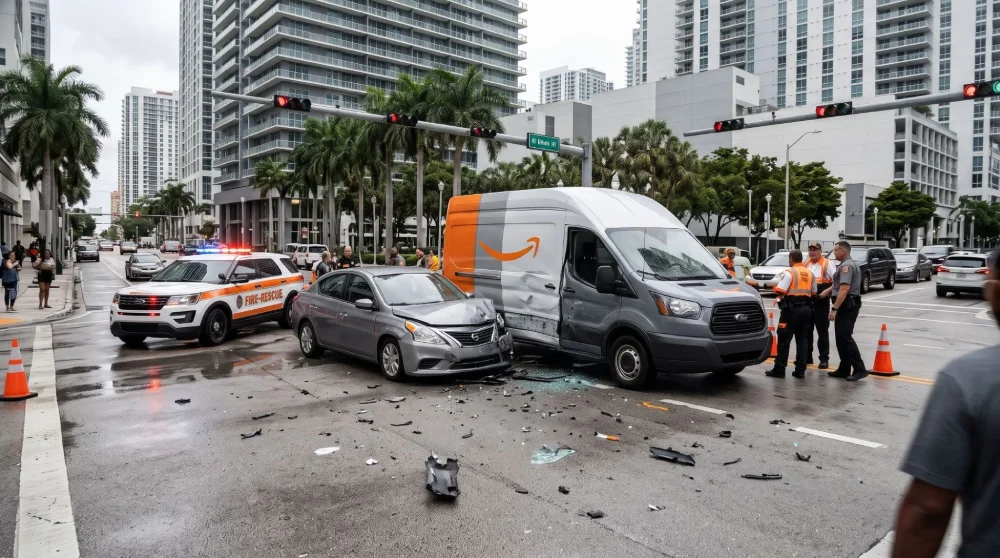
Miami Delivery Truck Accident Lawyer: South Florida Delivery Driver Accidents and Understanding Liability After a Crash
Kaire & Heffernan injury attorneys help people injured in delivery vehicle crashes sort out the liability and insurance issues that make these cases different from ordinary car accidents. If you were hurt in a Miami collision involving a delivery van, box truck, or other delivery vehicle, the key questions often go beyond who caused the crash: Was the driver working at the time? Who owned or controlled the vehicle? Did an employer, delivery company, contractor, or insurance policy have a role?
The answers depend on the facts, the driver’s work arrangement, and the applicable insurance policies. A company’s name or logo on a vehicle does not, by itself, establish that the company is legally responsible. This article explains how courts analyze fault and legal responsibility in these cases, how employee and independent contractor roles can change the outcome, what insurance coverage may apply, what evidence to preserve, how Florida’s comparative fault rules can affect compensation, and what steps you can take to pursue a claim.
Key takeaways
- Responsibility depends on the facts. A driver, employer, contractor, vehicle owner, or more than one party may be responsible, depending on the evidence and applicable law.
- A contractor label does not automatically resolve liability. The written agreement matters, but so do the parties’ conduct and the crash circumstances.
- Insurance coverage is not uniform. Coverage can depend on the driver’s status, whether the driver was working, the type of delivery service, and the terms and exclusions of the relevant policies.
- Preserve evidence early. Photographs, witness information, video, vehicle data, and delivery-app records may help establish what happened. The availability and retention period of electronic data vary.
- Florida’s comparative-fault rule can affect recovery. In many negligence cases, an injured person’s share of fault reduces damages; a plaintiff found more than 50 percent at fault generally cannot recover, subject to statutory exceptions.
Why can delivery-vehicle crashes be legally complex?
A crash involving a courier, package-delivery vehicle, or other commercial vehicle may require investigation of several issues, including:
- Whether the driver was making a delivery or otherwise acting within the scope of work.
- Whether the driver was employed by a company or working through a separate contractor.
- Who owned, leased, maintained, or controlled the vehicle, since these claims may involve multiple parties.
- Whether negligent hiring, training, supervision, or vehicle maintenance contributed to the crash.
- Which insurance policies may apply and what those policies cover.
Effective representation in delivery truck accident cases often depends on knowledge of trucking regulations and liability issues, including rules enforced by the Federal Motor Carrier Safety Administration.
The analysis is specific to the facts. A company’s contract may describe a driver as an independent contractor, but that label alone does not answer every question about agency, control, or responsibility. Nor does the fact that a driver was delivering goods automatically make a delivery company liable. Potential claims and defenses must be assessed using the evidence and governing law. For more on how safety guidelines govern motor vehicle operations, review resources from the National Highway Traffic Safety Administration.
Who may be responsible for an Amazon delivery crash?
Amazon-related crashes may involve a driver employed by a Delivery Service Partner, a driver using a personal vehicle through Amazon Flex, or another delivery arrangement, and a Miami delivery truck accident may arise when the Amazon vehicle is a delivery truck or similar commercial vehicle. The identity of the driver’s employer or contracting business, the driver’s work status at the time of the crash, and the relationships among the parties can all matter.
Truck accident claims may require investigating:
- The driver’s work or delivery agreement.
- Whether the driver was assigned or performing a delivery when the crash occurred.
- The identity and role of any delivery service provider and each responsible party connected to the crash.
- Vehicle ownership and maintenance.
- The insurance policies that may cover the driver or vehicle.
- Evidence bearing on negligent hiring, training, supervision, or other direct negligence claims.
Our experienced attorneys will also investigate whether Amazon exercised enough control over the driver’s work to affect liability despite an independent-contractor label.
Do not assume that a company is liable simply because a driver was carrying its packages, or that it cannot be liable because a contract calls the driver an independent contractor. The outcome depends on the particular legal theory and facts.
How may liability differ for UPS, FedEx, and food-delivery drivers?
Companies use different operating models. Some drivers may be company employees; others may work for contractors or service providers. Food-delivery drivers may use personal vehicles, while delivery trucks and other large commercial vehicles may be covered by personal, commercial, or platform-related insurance, depending on the circumstances, the vehicle, and the policy language.
Delivery companies and their insurers often fight hard against payouts, which can complicate coverage and liability disputes.
The coverage inquiry should not begin with a presumed dollar limit. It should identify the applicable policies and review their terms, exclusions, limits, and the driver’s status at the time of the crash. For example, Florida law requires specified insurance coverage for transportation network companies and their drivers in covered periods of prearranged rides. Those statutory requirements concern rides arranged through a transportation network company; they should not be treated as a universal insurance rule for food or package delivery.
“An ABC driver is an independent contractor and not an employee of the ABC if all of the following conditions are met.”
That provision concerns the statutory status of qualifying transportation network company drivers. It does not establish that every food-delivery or package-delivery driver is an independent contractor, or that every delivery platform provides the same coverage.
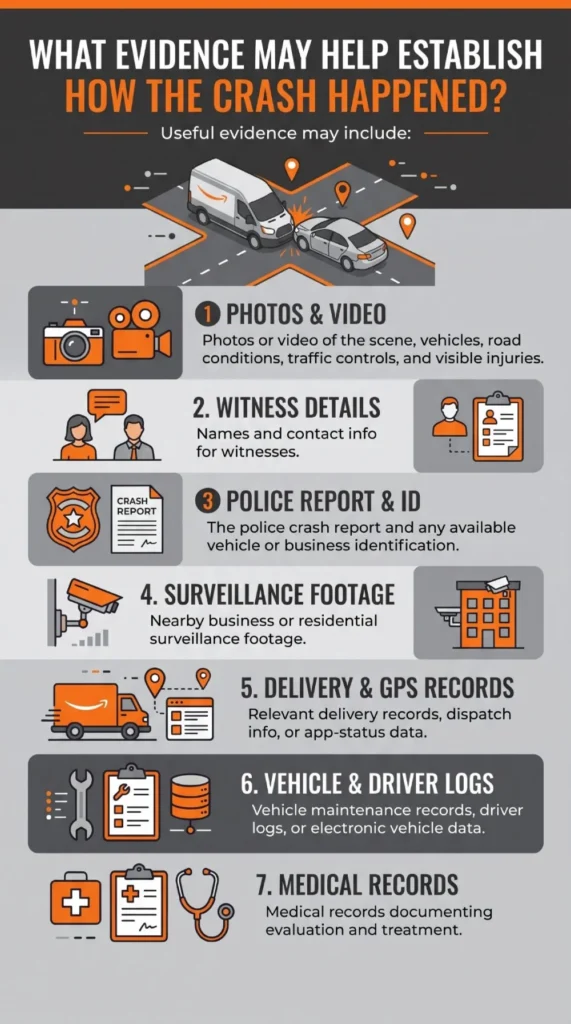
What evidence may help establish how the crash happened?
Useful evidence may include:
- Photos or video of the scene, vehicles, road conditions, traffic controls, and visible injuries.
- Names and contact information for witnesses.
- The police crash report and any available vehicle or business identification.
- Nearby business or residential surveillance footage.
- Relevant delivery records, dispatch information, or app-status data.
- Vehicle maintenance records, driver logs, or electronic vehicle data, if available and relevant.
- Medical records documenting evaluation and treatment.
The records that exist, who controls them, and how long they are retained vary by company, vehicle, and system. Our lawyers may also consult accident reconstruction experts early to help determine how the crash happened and support the preservation of key evidence. A trucking company may be required to retain certain records for limited periods, including at least six months after a crash and, for some vehicle-maintenance records, up to one year. Not every delivery vehicle must have an electronic logging device, and not every vehicle has a retrievable “black box” that records information a claim may need. A preservation request can identify relevant materials and ask that they not be destroyed, but it does not guarantee that the materials exist or that the recipient will preserve them.
Can delivery schedules or app activity be relevant?
They may be relevant if evidence connects the driver’s work demands, device use, or driver fatigue to the crash. For example, delivery records or app activity could help establish what the driver was doing, when the driver was working, or whether the driver was interacting with a device in a truck accident. But a delivery target, route estimate, or algorithm does not by itself prove that a company caused a crash or is legally responsible.
Any claim about corporate pressure, unsafe scheduling, or distracted driving should be supported by evidence specific to the truck driver, the company, and the incident, including whether hours-of-service or similar safety rules may apply.
What compensation may be available after delivery-vehicle and truck accident claims?
Depending on the facts and applicable law, injury victims may pursue compensation after delivery-vehicle and truck crashes for damages such as:
- Past and future medical expenses.
- Lost wages and, where supported, loss of future earning capacity.
- Pain and suffering and other legally recoverable non-economic damages.
- Property damage.
Our legal team’s goal is to document losses and seek maximum compensation allowed by the facts and law.
In limited cases involving extreme negligence, punitive damages may be available. In fatal cases, families may also pursue wrongful death damages, depending on the survivor and the losses recognized by law.
The available damages depend on the evidence, the nature of the claim, applicable statutory requirements, and any defenses. The seriousness of an injury alone does not establish who is liable or whether fair compensation may be recovered. Review consumer protection rules and insurance frameworks via the Florida Department of Financial Services.
How does comparative fault affect a Florida claim?
Florida’s comparative-fault statute generally reduces a plaintiff’s damages by the plaintiff’s percentage of fault in crashes involving trucks and passenger vehicles. In a negligence action to which the modified comparative-fault rule applies, a plaintiff found to be more than 50 percent at fault may not recover damages. Statutory exceptions and the facts of the case can affect the analysis.
“In a negligence action to which this section applies, any party found to be greater than 50 percent at fault for his or her own harm may not recover any damages.”
An insurer’s account of the crash does not determine fault alone. Relevant evidence may include the crash report, physical evidence, witness statements, video, and expert analysis where appropriate.
What can accident reconstruction and medical evidence show in cases involving spinal cord injuries?
Depending on the issues in dispute, expert analysis may help explain vehicle movement, visibility, impact forces, or causation in serious or catastrophic collisions, especially when fault is contested. Medical evidence may help document diagnosis, treatment, prognosis, and whether an injury is related to the crash, and traumatic brain injuries are frequent in delivery truck accidents.
Experts do not replace the underlying evidence. Whether expert testimony is appropriate, admissible, or necessary depends on the particular case and the issues the parties dispute.
What should you do after a delivery vehicle crash?
After a crash, consider these practical steps:
- Call 911 when appropriate. Request emergency help and report the collision. If you can do so safely, move out of harm’s way and avoid obstructing the road to reduce the risk of further collisions.
- Get medical attention. Seek medical attention promptly, even if symptoms seem minor, since some injuries may not be immediately apparent. In Florida, personal injury protection coverage may affect early payment of medical and disability benefits after a motor-vehicle crash.
- Document the scene if it is safe. Photograph the vehicles, license plates, identifying markings, roadway, damage, and visible injuries.
- Collect witness information. Obtain names and contact details when possible.
- Exchange information and report the crash as required. Follow applicable reporting requirements and cooperate with law enforcement.
- Keep relevant records. Save medical records, bills, repair estimates, correspondence, and any delivery-related information provided to you.
- Be careful with statements. You may provide information required by law or needed to report the crash, but contact the truck accident lawyers at Kaire & Heffernan before speaking in detail with insurance adjusters or giving a recorded statement to an adverse insurer.
A request for a crash report may be made through the appropriate law-enforcement agency or the Florida Highway Safety and Motor Vehicles process. The agency that investigated the crash may depend on where it occurred.
Frequently asked questions
What if an Amazon Flex driver hit my car?
Document the crash, identify the driver and vehicle, report the collision, and seek medical care if needed. This kind of personal injury claim may depend on the driver’s work status and the coverage available under the circumstances and policy terms. Do not assume that either the driver’s personal policy or a platform policy necessarily covers the loss. A Miami truck accident lawyer can help preserve evidence and identify each liable party.
Can I bring a claim involving FedEx or UPS?
A claim may be possible in truck accident cases involving FedEx or UPS, including a collision with a delivery truck or semi truck, if evidence supports a legal basis for liability. Relevant questions may include who employed or contracted with the driver, whether the driver was working, and which insurance policies apply. A company’s name on the vehicle alone does not decide those questions. When a commercial truck is involved, applicable insurance may include federally required liability coverage, which for many motor carriers is at least $750,000.
How long do I have to file a lawsuit in Florida?
Deadlines depend on whether the matter is a personal injury claim or a wrongful death claim, as well as the circumstances. Florida law generally sets a two-year limitations period for negligence actions and wrongful death claims, but exceptions, other potentially applicable deadlines, and the facts of a particular case can change the analysis. Missing a deadline can bar a claim, so the applicable deadline should be confirmed promptly to help preserve a Miami truck accident case. A lawyer can also guide clients through the legal process, including evaluating the claim, gathering evidence, and meeting filing deadlines.
Are food-delivery drivers insured while making deliveries?
Coverage depends on the driver’s status, the platform and delivery arrangement, and the policy language. The Florida statutory coverage rules for transportation network companies address qualifying prearranged rides; they should not be assumed to govern every food-delivery claim.
What evidence may show that a driver was using a phone or delivery app?
Potentially relevant materials may include available video, witness observations, app or dispatch records, and other electronic data obtained through appropriate procedures. Whether such evidence exists and can be obtained depends on the facts, the systems involved, and applicable law.
Will a delivery-vehicle case go to trial?
Some truck accident claims resolve without trial; others proceed to litigation or trial. Delivery companies and insurers often have legal teams evaluating exposure early, which can shape settlement and trial strategy. The outcome depends on the facts, evidence, disputed legal issues, and the parties’ decisions. No particular fair settlement can be guaranteed.
How much does it cost to hire a lawyer?
Fee arrangements vary by firm and case, our truck accident lawyers handle these matters on a contingency fee basis. Kaire & Heffernan offers a free consultation, and the written fee agreement should explain attorney fees and responsibility for case costs before representation begins.
What types of injuries are most common in delivery truck collisions?
Due to the massive weight and size disparity of commercial delivery trucks, victims frequently suffer severe injuries including traumatic brain injuries, spinal cord paralysis, complex fractures, and internal organ damage.
How can I get a copy of the police crash report in Miami?
Police crash reports can be requested directly through the Florida Highway Safety and Motor Vehicles portal or obtained via the investigating law enforcement agency, such as the Miami-Dade Police Department or City of Miami Police.
About Kaire & Heffernan and Our Free Consultation
Kaire & Heffernan helps injury victims and truck accident victims seeking legal representation after a Miami truck accident or a delivery-vehicle crash. A delivery-vehicle claim requires assessing crash evidence, the parties’ relationships, applicable insurance, and the governing law. These cases may involve identifying every party responsible for the crash, including a trucking company, vehicle manufacturers, cargo loaders, and maintenance providers. These crashes can cause serious injuries, catastrophic injuries, steep medical bills, and ongoing medical treatment. In Miami-Dade County, 2024 saw 8,546 commercial vehicle crashes and 1,364 related injuries; statewide, Florida recorded 368 fatalities in large truck crashes, including crashes involving semi truck traffic and other large commercial vehicles.
This article provides general information, not legal advice. The law and filing deadlines can depend on the facts of an individual case.