


 (305) 876-6001


Florida Personal Injury Appeals and Medical Malpractice Cases: What to Know After a Verdict
An appeal of a personal injury or medical malpractice verdict asks an appellate court to review the trial-court record for legal error, not to retry the case or reweigh the evidence. If you are involved in a Florida personal injury or medical malpractice case and are considering whether to appeal a verdict or ruling, the steps and deadlines depend on the order being challenged, any authorized post-trial motions, and the particular issues raised.
This overview explains the Florida appeal process in those cases, including standards of review, issue preservation, timing, motions that affect appellate rights, which rulings can be appealed, appellate briefs, oral argument, possible outcomes, and related procedural issues such as stays of judgment enforcement. Because appellate rules are strict and deadlines can control whether review is available at all, understanding how a Florida personal injury appeal works can directly affect your ability to pursue justice and compensation after a trial court decision.
Key Takeaways
- Appeals are not retrials. The appellate court generally reviews the trial court record and applies the appropriate standard of review to each issue.
- Deadlines matter. A notice of appeal from a final order generally must be filed within 30 days after the order is rendered. Certain listed nonfinal orders also may be appealed within 30 days. Other nonfinal rulings generally must await final judgment or qualify for another form of review.
- Preserving an issue is important. A party generally must raise an issue in the trial court in a manner that gives the judge a fair opportunity to address it. The requirements vary by issue.
- Post-trial motions can affect appeal timing. Certain timely and authorized motions, including motions for new trial, remittitur, or additur, toll rendition of a final order until the motion is resolved.
- An appeal does not automatically stop collection. A party seeking to stay enforcement of a money judgment generally must obtain a stay and satisfy applicable security requirements.
What does a personal injury appeal involve?
An appeal in a Florida personal injury or medical malpractice case is part of the appeals process, asking an appellate court to review specified rulings and proceedings in the trial court record rather than retry the case. It is not an opportunity to retry the case, present new evidence, or ask appellate judges to reassess witness credibility as though they had heard the testimony themselves. According to data tracked by the National Institutes of Health (NIH) PMC database, complex civil and medical litigation claims frequently involve extensive procedural histories before achieving final resolution. Furthermore, reports published by the Agency for Healthcare Research and Quality (AHRQ) emphasize that systemic medical errors remain a prominent driver of complex health litigation.
Depending on the issue in a personal injury case, an appeal may ask the appellate court to review the lower court decision for legal errors in such matters as:
- The interpretation or application of a statute or rule.
- A ruling admitting or excluding evidence.
- A jury instruction or verdict form.
- A ruling on a motion for directed verdict or for judgment in accordance with a prior directed-verdict motion.
- A post-trial ruling, including a ruling on a motion for new trial, remittitur, or additur.
The appellate court may affirm the ruling, reverse it, or remand the case with instructions. Whether an error warrants relief depends on the applicable law, the record, and the error’s effect; not every error is reversible, and the court considers whether it affected the losing party or the trial’s outcome.
How do appellate courts review trial court decisions and jury verdicts?
There is no single standard of review for every appellate issue. The standard depends on the type of ruling challenged and the nature of the trial court’s decision.
| Type of issue | General standard |
| Legal questions, including statutory interpretation | Generally reviewed de novo, without deference to the trial court’s legal conclusion. |
| Many evidentiary and discretionary rulings | Generally reviewed for abuse of discretion, with the appellate court asking whether the trial court’s ruling fell outside the range of reasonable choices, subject to any legal questions embedded in the ruling. |
| Factual findings in a nonjury case | Commonly reviewed to determine whether they are supported by competent, substantial evidence. |
| A ruling on whether the evidence is legally sufficient to submit an issue to the jury | Governed by the applicable legal-sufficiency standard, not simply by asking whether the verdict is supported by competent, substantial evidence. |
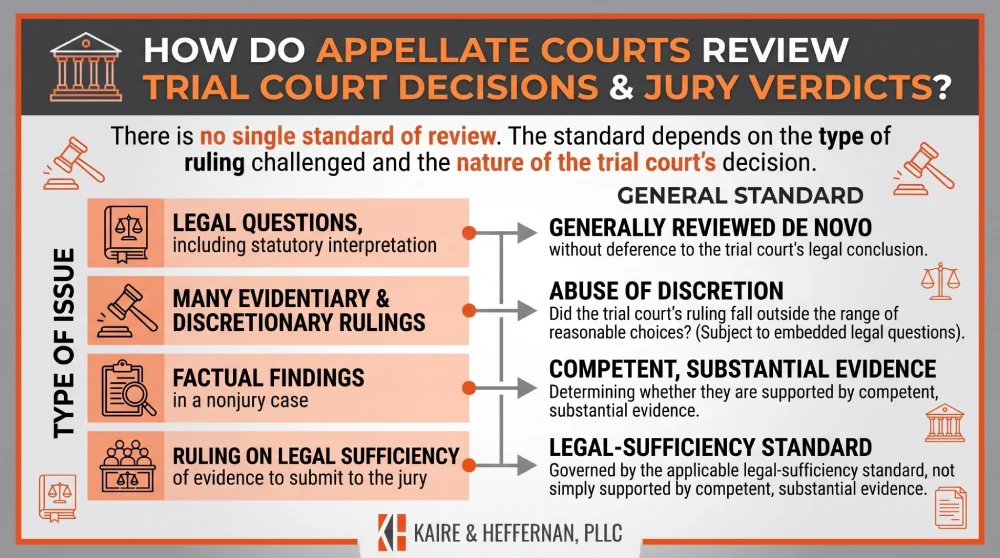
Some appeals challenge trial court rulings, and the standard depends on the nature of those rulings and the legal issue presented. De novo review gives no deference to the trial court’s decision, while other standards may. The applicable standard should be confirmed for the particular issue and appellate district.
Rulings involving expert testimony also should not be characterized categorically as discretionary. Although evidentiary rulings are generally reviewed for abuse of discretion, an appellate court may evaluate the trial court’s exercise of discretion differently from a pure legal question, which may be reviewed de novo. Safety evaluations and regulatory product compliance standards maintained by the U.S. Food and Drug Administration (FDA) often form the technical backbone of expert testimony challenged in these appeals.
What are the deadlines for a Florida appeal?
A notice of appeal from a final order generally must be filed with the clerk of the lower tribunal within 30 days after rendition of the order. Florida’s appellate rules define rendition as the filing of a signed, written order with the clerk. The rules also identify certain timely and authorized motions that toll rendition, including motions for new trial, remittitur, or additur.
“Jurisdiction of the court under this rule must be invoked by filing a notice with the clerk of the lower tribunal within 30 days of rendition of the order to be reviewed.”
A separate 30-day deadline generally applies to an appeal from a nonfinal order that is authorized for immediate review. Not every pretrial or interlocutory order is appealable at once. In particular, a motion for rehearing or reconsideration should not be assumed to extend the deadline for appealing a nonfinal order.
Because timeliness can determine whether appellate review is available, our legal team will identify the order being challenged, confirm when it was rendered, and determine whether any motion is authorized and timely. The effect of a post-trial motion can depend on its legal basis and the rules governing that motion.

Why does preservation of error matter?
An appellate court generally will not reverse on an issue not properly raised in the trial court unless a recognized exception applies. Preservation gives the trial judge a fair opportunity to address the claimed error and creates a record the appellate court can review later when a party argues specific legal errors or procedural mistakes.
Depending on the issue, preservation may require:
- A timely and specific objection.
- A request for a ruling and a clear ruling from the court.
- A written motion or other filing required by the applicable rule.
- A proffer when evidence is excluded, so the record shows what the evidence would have been.
- Compliance with any issue-specific procedure for challenging a verdict or jury instruction.
Problems during the trial process, including jury selection, may support appellate review if they were properly preserved and reflected in the record. Improper jury instructions, juror misconduct, or attorney misconduct may present appeal issues when they affected the outcome and were preserved under the applicable procedural rules.
The precise requirements vary. Not every issue can be preserved simply by objecting, and not every unpreserved issue is automatically reviewable. Trial and appellate counsel should assess preservation issue by issue. Additional guidelines on medical injury documentation are available through the National Library of Medicine (NLM).
What are the roles of the appellate briefs and oral argument?
The parties present their legal arguments primarily through written briefs supported by citations to the record and legal authorities. In a typical appeal, the appellant files an initial brief, the appellee files an answer brief, and the appellant may file a reply brief. The applicable appellate rules govern the briefing schedule and required contents.
The record on appeal is central. It generally consists of designated trial-court documents and transcripts, and the governing rules, along with any directions or orders concerning the record, require careful review. Appellate courts generally decide the case based on that record rather than new evidence.
Transcripts of trial proceedings should be ordered promptly, and an appellate attorney uses the record, legal research, and legal precedents to develop persuasive legal arguments. Oral arguments may be requested or scheduled under the applicable rules and court procedures. It is an opportunity for the panel to question counsel about the issues; it is not guaranteed in every case and does not replace the written briefs.
Can a party appeal a partial summary judgment or another pretrial ruling immediately?
Sometimes, but immediate review of nonfinal orders is limited. The correct rule is Florida Rule of Appellate Procedure 9.130, not Rule 1.130. Rule 9.130 identifies categories of nonfinal orders that may be appealed, including certain orders concerning venue, injunctions, personal jurisdiction, arbitration, and class certification.
Other nonfinal rulings, including many evidentiary decisions and partial summary judgments, generally are not immediately appealable under that rule. They may be reviewable on appeal from a final judgment, depending on the circumstances and the governing rules.
In limited circumstances, a party may seek extraordinary review, such as certiorari. That is a separate and demanding form of review, not a substitute for an appeal as of right. Whether it is available depends on the nature of the order and the applicable legal standard.
What can happen if the appellate court reverses?
The result depends on the error and the relief warranted. An appellate court reviews the trial court’s decision and may affirm, reverse, or, when warranted, return the case to the lower court for further proceedings. A remand may require a new trial, reconsideration of a particular issue, entry of a different judgment, or another action consistent with the appellate court’s decision.
A reversal does not necessarily end the case or establish that one party wins. The appellate court’s decision and instructions determine what happens next. The outcome may also depend on whether the error could significantly impact the judgment or damages awarded and whether the record supports the relief requested. The goal is a more favorable outcome, which may include a new trial or a different judgment depending on the record.
How can remittitur and additur affect an appeal?
Florida law authorizes a trial court, on a proper motion in a covered action, to review the damages awarded in a verdict for excessiveness or inadequacy. The statute directs the court to consider specified factors, including whether the award reflects prejudice or passion, whether the jury ignored or misconceived evidence, and whether the amount bears a reasonable relationship to the damages proved and the injury suffered.
“If the party adversely affected by such remittitur or additur does not agree, the court shall order a new trial in the cause on the issue of damages only.”
A party’s options and the consequences of a remittitur or additur depend on the order and the statute’s requirements. These issues may be raised after the initial trial and can affect whether a party seeks post-trial relief or an appeal. A timely, authorized motion for remittitur or additur also tolls rendition for purposes of the appeal deadline. The motion should therefore be evaluated both on its merits and for its effect on appellate timing.
Does filing an appeal stop collection of a judgment?
No. Filing an appeal does not, by itself, stay enforcement of a money judgment. A party seeking to prevent enforcement while an appeal is pending generally must obtain a stay and comply with the applicable requirements for a bond or other security. The procedure and any limits depend on the type of judgment and the governing law.
A stay should not be assumed to be automatic. Parties should promptly assess the available procedures, deadlines, amount of security, and any applicable statutory provisions.
Why coordinate trial and appellate strategy?
Potential appellate issues often depend on what happened before and during trial. While trial work builds the record, appellate work relies on that record but requires a different kind of legal analysis. Decisions about motions, objections, jury instructions, evidentiary rulings, and the record can affect whether an issue is available for appellate review and how it will be evaluated. In many cases, trial counsel and trial lawyers may work with an appellate lawyer for issue preservation, strategic guidance, and motions practice, including support on dispositive motions.
Kaire & Heffernan represents clients in personal injury and medical malpractice matters in South Florida. For clients considering an appeal or responding to one, the firm’s appellate practice handles civil appeals in state and, where applicable, federal courts, including related commercial matters such as business torts, and our experienced attorneys can explain the appellate process and the broader legal process. The appropriate strategy depends on the facts, the order, and the applicable law.

About Kaire & Heffernan
Kaire & Heffernan is a law firm that represents people in personal injury and medical malpractice matters in Miami and throughout South Florida, including appellate matters. The firm offers a free consultation to discuss appeal options for appellate clients. The firm handles cases involving serious injuries and complex litigation, with attention to the record, the applicable law, and the client’s objectives. It serves clients in Miami, Fort Lauderdale, and elsewhere in South Florida, and Broward appeals are heard in the Fourth District Court of Appeal in West Palm Beach. The firm brings a strong track record to appellate matters, then applies appellate law through a careful review of the record and can assess whether there is a basis to challenge the verdict.
This article provides general information, not legal advice. The law and filing deadlines can depend on the facts of an individual case.