


 (305) 876-6001

Semi Truck Blind Spot Accidents and Liability in Florida Commercial Vehicle Collisions
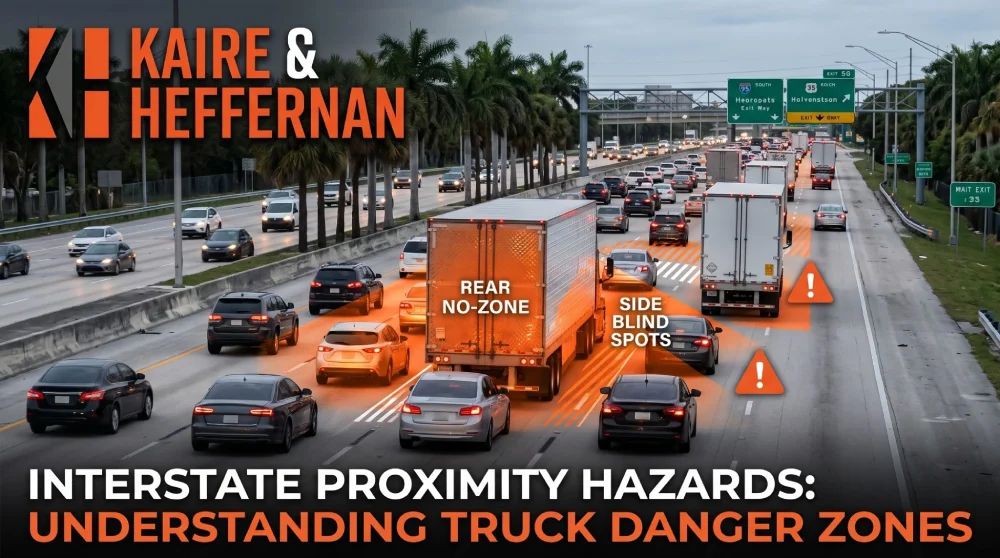
Semi-trucks have large blind spots that drivers may not see clearly, even with mirrors. These areas, often called “no-zones,” can make lane changes, turns, and other maneuvers especially dangerous when passenger vehicles are nearby.
When a truck and passenger vehicle collide, the truck driver’s visibility limitations may be relevant, but they do not determine legal responsibility. Liability depends on the crash circumstances, the conduct of those involved, and the available evidence.
Key Takeaways
- Safe operation: Truck drivers must use reasonable care when changing lanes, turning, merging, and operating near other vehicles. Applicable traffic laws and safety regulations may also be relevant.
- Comparative fault: In most negligence actions covered by Florida’s comparative-fault statute, a plaintiff’s damages are reduced in proportion to the plaintiff’s share of fault. A plaintiff found more than 50 percent at fault for their own harm generally may not recover.
- Potentially responsible parties: Depending on the facts, a claim may involve the driver, motor carrier, vehicle owner, maintenance provider, cargo loader, shipper, or a product manufacturer.
- Evidence matters: Vehicle data, electronic logging records, photographs, witness accounts, and inspection or maintenance records may help establish how a collision occurred.
What Are the Main Blind Spots Around a Semi-Truck?
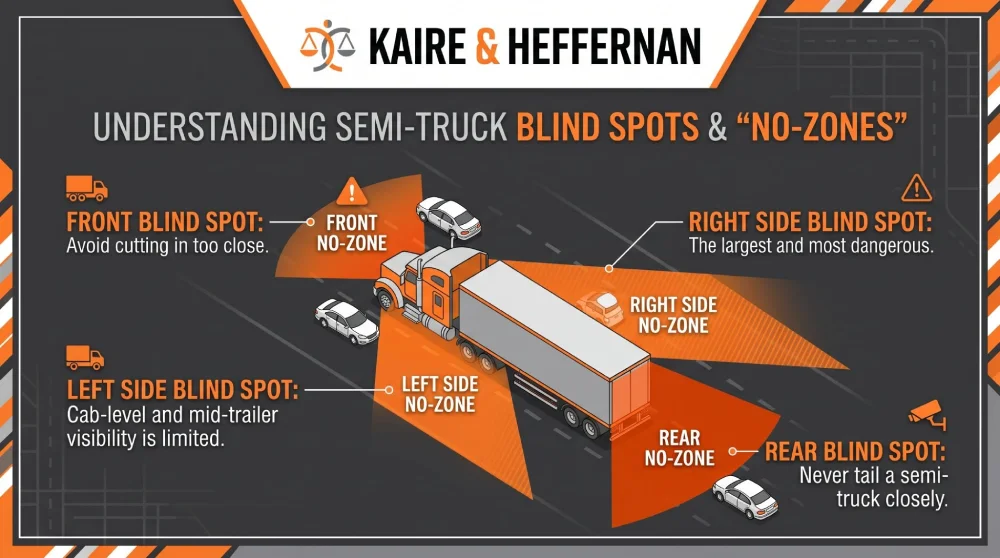
Truck blind spots are areas where the tractor, trailer, mirrors, vehicle design, or surrounding conditions may limit a driver’s view. Areas of concern may include the area directly in front of the truck, behind the trailer, and alongside the truck, particularly on the passenger side.
Blind spots vary by truck. Their size and location can vary with the vehicle’s design, trailer configuration, mirror adjustment, roadway conditions, and the passenger vehicle’s position. Some trucks also have cameras, radar, or other systems that may assist the driver, but the availability and operation of that equipment vary.
A truck driver may have difficulty seeing a passenger vehicle in certain positions. That alone does not establish that either driver was legally at fault. Evidence about the drivers’ actions, the timing of the maneuver, the traffic conditions, and the truck’s equipment can all matter.
How Is Liability Determined in a Florida Blind-Spot Truck Crash?
A blind spot may help explain how a truck driver failed to see another vehicle, but a driver’s limited visibility does not automatically excuse an unsafe maneuver. In semi-truck blind-spot accidents, crashes often happen in No-Zones, yet a commercial truck driver remains responsible for completing the trip safely and may remain liable when a lane change, merge, or turn is not performed safely. A central question is whether the driver acted reasonably under the circumstances, including whether the driver checked available mirrors and other equipment and proceeded only when the maneuver could be completed safely. Driver fatigue and distracted driving can also contribute to these crashes. Drivers should signal early and check mirrors frequently before changing lanes, merging, or turning.
Florida’s comparative-fault statute generally reduces a claimant’s damages according to the claimant’s share of fault. Comparative negligence allows multiple parties to share liability, reducing damages according to each party’s percentage of fault. It also bars recovery in covered negligence actions when a party is found more than 50 percent at fault for their own harm. The statute broadly defines a negligence action to include actions based on negligence, strict liability, products liability, professional malpractice, and breach of warranty theories.
The facts may support claims involving a driver’s operation of the truck, a motor carrier’s conduct, maintenance or loading practices, or a defective vehicle component. Evidence of safety violations may play a major role in proving negligence, including poor maintenance, stopping distance, or driver conduct, and trucks can take up to 40% longer to stop than passenger cars because of their weight. Each theory requires strong evidence supporting the applicable legal elements, including causation.
What Evidence Can Help in Proving Negligence After a Truck Accident?
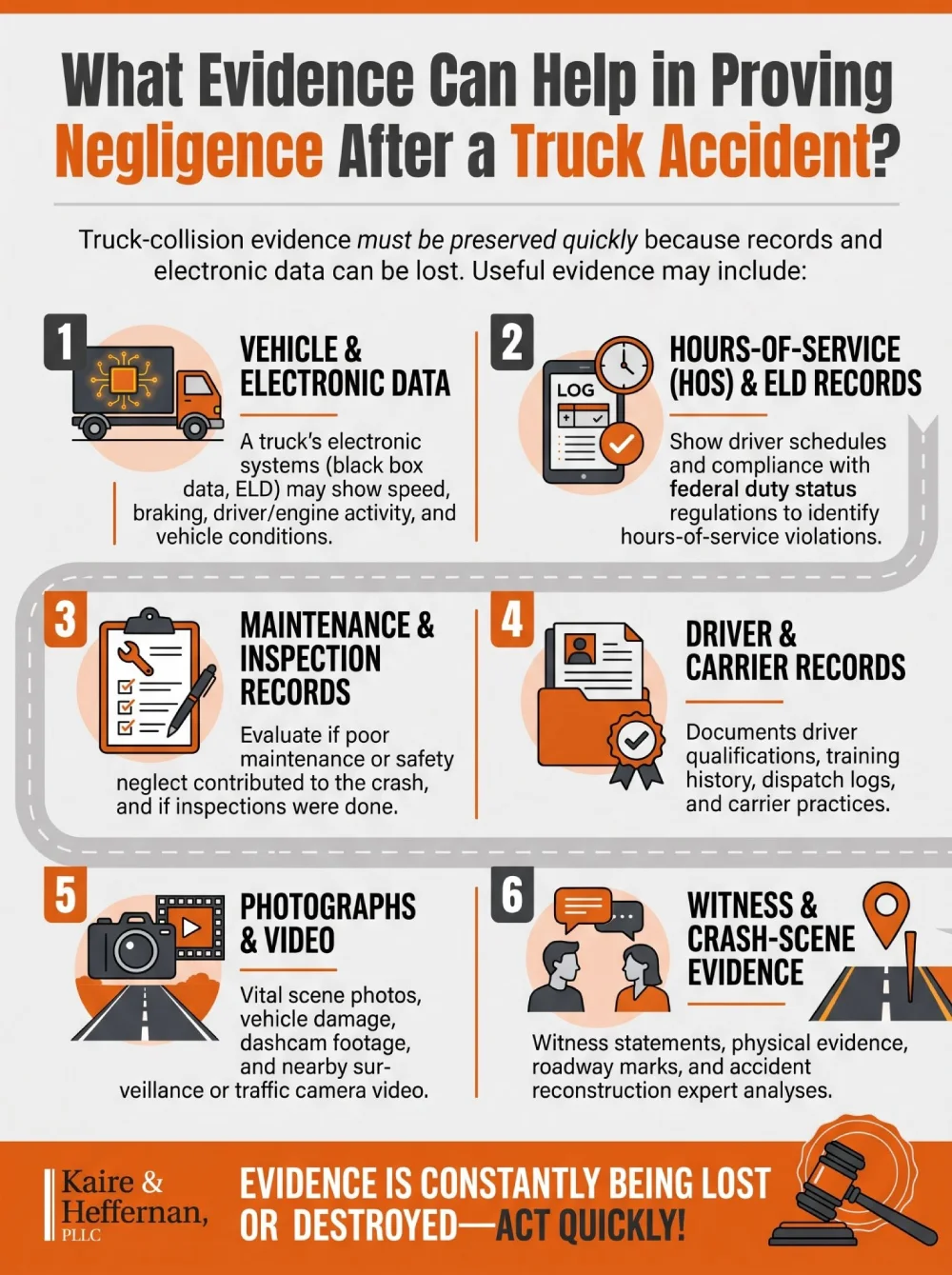
Truck-collision evidence can be important and should be preserved quickly because some records and electronic data may not last, and our attorneys need to act fast to preserve inspection records before they are lost. Depending on the circumstances, useful evidence may include:
- Vehicle and electronic data: A truck’s electronic systems may contain information such as black box data and a truck’s electronic logging device data, which may help show speed, braking, driver activity, engine activity, or other vehicle conditions. Available data and retention periods vary by truck and system.
- Hours-of-service and electronic logging records: These records may help assess a driver’s schedule and compliance with applicable requirements. Federal regulations address drivers’ records of duty status and electronic logging devices in circumstances where those rules apply, and violations may matter in proving negligence when tied to the collision.
- Maintenance and inspection records: These records help evaluate truck maintenance and determine whether a relevant vehicle condition was identified, reported, repaired, or left unaddressed, including whether poor maintenance contributed to the collision. They can also show whether required inspections were performed and whether safety duties were breached.
- Driver and carrier records: Qualification, training, dispatch, and other records can be relevant to particular claims, depending on the facts.
- Photographs and video: Scene photographs, vehicle damage, dashcam footage, surveillance footage, nearby surveillance video, and traffic-camera footage can help establish vehicle positions and movements and support a negligence claim.
- Witness and crash-scene evidence: Witness accounts, physical evidence, roadway markings, and accident reconstruction experts may help explain how the collision occurred as part of a thorough investigation.
The presence or absence of a particular electronic system, or a record of a regulatory violation, does not by itself establish liability. The evidence must be evaluated in context and connected to the collision and claimed injuries.
Frequently Asked Questions About Semi-Truck Blind-Spot Accidents
1. Who may be held liable in a Florida semi-truck blind-spot collision?
Potentially responsible parties may include the driver, motor carrier, vehicle owner, maintenance provider, cargo loader, shipper, or manufacturer. A trucking company may also be held liable for a driver’s negligence, depending on the relationship and the facts, and identifying the liable party turns on the evidence and legal theory. For example, a manufacturer is not liable merely because a truck lacked optional blind-spot technology; a product claim requires evidence supporting a legally recognized defect or other basis for liability and a connection to the harm.
2. What should I do after a truck accident in Miami or elsewhere in Florida?
Prioritize safety and medical care, and contact law enforcement when appropriate. If it is safe to do so, document vehicle positions, damage, road conditions, and visible identifying information. Get contact information for witnesses and keep records related to medical care and expenses.
Avoid giving a recorded statement to the trucking company’s insurer or signing a release before you understand its effect. Depending on the facts and applicable law, injury victims may later seek compensation for losses such as medical expenses and lost wages. Evidence may be time-sensitive, so act fast to preserve evidence before it is lost or controlled by others. Speaking promptly with a truck accident lawyer or accident lawyer can help protect your rights, explain your legal options, and preserve time-sensitive evidence.
3. How long do I have to file a truck accident lawsuit in Florida?
Many ordinary negligence claims arising after Florida’s 2023 limitations-period change are subject to the filing deadline set by the applicable statute, but the deadline depends on the claim and its circumstances. Different rules or requirements may apply to wrongful-death claims, claims involving government entities, and other specialized matters. The applicable statute may differ for government-related claims or other specialized matters, so confirm it promptly with our legal team. Assess the date a claim accrues and any applicable exceptions promptly.
4. Can I recover compensation if my vehicle was in the truck’s blind spot?
Possibly. Under Florida’s modified comparative negligence rule, a plaintiff who is partly at fault may still recover compensation if they are not more than 50 percent responsible, though damages are reduced in proportion to their share of fault. A plaintiff found more than 50 percent at fault for their own harm generally may not recover under the statute. Whether the plaintiff or another party was at fault depends on the evidence.
5. What damages may be recoverable in a commercial trucking lawsuit?
Under Florida law, accident victims may recover compensation for financial and personal losses, including medical expenses, lost income, diminished earning capacity, physical pain, mental anguish, disability, disfigurement, special damages, and other losses in an appropriate tort claim. Available damages depend on causation, proof, and the claim’s circumstances. Families often ask how much compensation may be available, and severe or permanent injuries can increase case value and, in some matters, if the facts and law allow, support damages beyond basic no-fault coverage and lead to settlements exceeding millions of dollars as part of a claim for full compensation. In limited cases, punitive damages may be available when a liable party acted maliciously, intentionally, or with gross negligence, and surviving family members may pursue separate wrongful death damages when a victim dies.
6. How might a trucking company or insurer defend against a blind-spot crash claim?
A defense may argue that the passenger-vehicle driver contributed to the collision, and insurance companies may quickly claim the driver caused or helped cause the crash, for example, by changing lanes unsafely, traveling alongside the truck, failing to maintain a proper lookout, or failing to take reasonable evasive action. If supported by the evidence, comparative fault may reduce damages or, where the statutory threshold is met, bar recovery. Insurers may also push for an early settlement that does not reflect a fair settlement value if liability or injuries are disputed.
7. What role can truck safety technology play in a liability investigation?
If a truck had cameras, radar, or collision-warning systems, investigators may examine whether the equipment was installed, maintained, functioning, and used, and whether any issue contributed to the collision. The presence or absence of a particular system does not, by itself, establish liability.
8. Why can semi-truck collisions cause severe injuries?
Commercial trucks are substantially larger and heavier than passenger vehicles, though a truck’s weight depends on its configuration and cargo. In a collision, that size and weight disparity can contribute to catastrophic injuries, including paralysis, other serious injuries, or death. Driver error plays a major role in many of these crashes, and driver error causes over 80% of large truck crashes. The outcome of any particular crash depends on the circumstances.
9. How are federal trucking rules relevant to a Florida crash?
Federal motor-carrier regulations may apply depending on the vehicle, carrier, and operation. For example, fmcsa regulations may address records of duty status, electronic logging devices, and hours-of-service limits in specified circumstances, including the rule that limits truck drivers to 11 hours of driving after 10 hours off and the requirement that truck drivers must take a 30-minute break every 8 hours. Hours-of-service violations may point to driver fatigue, which can matter in a negligence claim because driver fatigue contributes to 30% of large truck crashes. Federal rules also restrict alcohol use, including that drivers cannot use alcohol within 4 hours of operating a commercial truck. Depending on the circumstances and applicable rules, a motor vehicle accident involving injury or property damage can trigger certain post-crash requirements. Evidence of distracted driving may also be relevant when evaluating fault. Whether a regulation applies, whether it was violated, and how the violation affects a civil claim are fact-specific questions.
10. How can I discuss a potential claim with Kaire & Heffernan?
You can contact Kaire & Heffernan for a free consultation about a potential claim and the legal options that may apply. Any decision about a potential claim should be based on the specific facts, available evidence, and applicable deadlines.
About Kaire & Heffernan
Kaire & Heffernan is a personal injury law firm that represents people injured in vehicle collisions in South Florida, including Miami, Aventura, Coral Gables, and Fort Lauderdale. The firm investigates trucking collisions as part of its personal injury work involving commercial trucks and other serious crashes, handles truck accident cases, and evaluates potential claims against drivers, trucking companies, and other responsible parties under applicable trucking-industry rules and records. Commercial carriers often have substantial coverage, and some must carry at least $750,000 in liability insurance, but recovering fair compensation still depends on the facts and evidence. Contact our legal team to discuss your situation with experienced attorneys and learn whether they can help. Our team can guide clients through the legal process, including quickly securing critical evidence for complex personal injury claims, taking a comprehensive approach to dealing with insurance companies, investigating negligence, and pursuing compensation for medical expenses and lost wages while clients focus on medical care and lost income.

This article provides general information, not legal advice. The law and filing deadlines can depend on the facts of an individual case.